

About Us
Criteria’s science-based assessments, interviews, and employee development resources empower companies of all sizes to hire and develop top talent. Uncover valuable insights throughout the employee journey with a user-friendly, comprehensive suite of tools, thoughtfully designed to help companies make better talent decisions, faster.
© 2026 Criteria Corp. All rights reserved
TRUSTED BY:

ON DEMAND WEBINAR ▶︎
Criteria Compass Series:
Stronger Signals for Better Interviews

My name is Jan Khan. I'm the CMO here at Criteria. I'll be your host today. Running time should be between forty to forty five minutes, which should give us, you know, a good amount of time to go through the questions that you all have. So please do ask questions. Don't be shy. And, again, share your perspectives as we go through this in the comment section. You know, keep the keep the virtual energy, going. And many of you, might be curious, but, yes, we will receive an on demand recording, and we'll be sharing all the content from here. Pretty action packed agenda. You know, I'll kick us off a little bit here and, general run a show, spend about the first ten minutes, just talking about how we can use AI to make better and and faster decisions. And spoiler alert, the answer is not just using more AI. So if there is fatigue there, hopefully, that comes as a bit of a relief. I'll then be doing a fireside chat with our chief technology and AI officer, Chris Staden, who I'll I'll properly introduce, you know, at the end of my section here. And then we'll dive into a little bit of practical show and tell, and and Rachel, our, director of product marketing, is gonna go through a little bit of a real world example of how to apply a lot of what we talk about today. We should have plenty of time for for q and a. So if you ask your questions during the session, it should give me a lot of time between myself, Chris, and Rachel to be able to answer your questions. Alright. So let's get into it. You know, I'm gonna start with probably the least controversial statement you're gonna hear all day. Yes. AI is transforming hiring. I know. Really bold prediction for twenty twenty six. Yeah. At this point, it feels like we're all contractually obligated to have at least one conversation about AI every day. But, look, underneath all the excitement, the anxiety, the fatigue, and the end of stream of new AI capabilities, is an important question, think, that's probably top of mind for everyone here. Is AI actually helping us make better hiring decisions? Because that's the goal for it. Right? Not more AI, not more automation, not doing everything we already do, just doing it faster, but how do we make better hiring decisions? And I do believe the answer depends much less on how sophisticated the AI is and more on what we're asking AI to work with. And that's what I wanted to spend a little bit of time on today. So let's talk about where I feel we're making one of the biggest mistakes with AI in hiring. We're applying AI before we've improved the signal. Take the resume, for example. For decades, we've known it's an imperfect proxy for potential. It tells us where someone worked. It tells us what titles they've held, how they describe their experience, but it doesn't really tell us whether a person can actually do the job. And now AI has introduced this really interesting dynamic. We know candidates are using AI to create and optimize resumes. It's almost impossible not to. We know a lot of employers are using AI to evaluate and rank those same resumes, and employers are doing it because it's become almost impossible to handle the application volume these days. So it all makes sense. But what's happening here is we're putting AI on both sides of an already imperfect signal, and you can see the consequences in the data. A study, conducted earlier this year by Lighthouse Research with close to a thousand respondents showed that ninety two percent of employers, you know, are saying AI generated resumes are now commonplace. Sixty four percent said they've hired someone who misrepresented their skills or experience, and nearly three quarters say identifying quality candidates is definitely getting harder. So the answer can't be more sophisticated screening of the same information. AI can make a weak signal faster, but it can't make it more predictive. And the biggest opportunity is to move towards evidence of what someone can actually do, proven skills, structured interviews, validated assessments, observed behaviors. It's a mindset and objective to not use AI to make faster decisions, but to use AI to help us make better decisions. So if we're gonna move away from weak signals, what should we move towards? Well, we need richer talent signals. When we talk about talent signals, we're talking about evidence that gives us a more meaningful view of someone's potential to succeed in the role. And there are a few characteristics that matter. The signal should be observable rather than simply self reported. It should be job related, so we're measuring something that actually matters for the role. It should be structured so candidates can be evaluated consistently. And most importantly, it should be predictive. We should have evidence that what we're measuring actually relates to future performance. That's what validated assessments, skills demonstration, work samples, a well designed structured interview can give us. The richer and more structured and more consistent the signal, the more useful than AI can be in helping us capture it, organize it, and amplify it. So instead of solving for where and how can we add AI to hiring, I think, you know, the better question we should be asking is how do we have a high quality talent signal that AI can help us get more value from? So before I go further, I also do wanna, clarify. Like, when I say talent signal, like, you know, what do we actually mean? What am I talking about here? Talking about meaningful evidence that helps us understand something about a candidate that matters for success. And what's important is that potential isn't one dimensional. It might be critical thinking or problem solving. It might be communication or emotional intelligence. It might be someone's ability to learn their attention to detail or how reliably they follow the rules. Different roles require different combinations of these signals, and we can uncover them in different ways through validated assessments, through skills demonstrations, you know, through structured interviews. And we're gonna double click a little bit into that here and and show more of that. But the goal here isn't to collect more data about a candidate. It's to uncover the right signals about that candidate, and that's sort of the crucial distinction as we think start thinking about where and how to apply AI. So we know the kind of talent signals we're looking for. Now the next question is, like, how do we capture them reliably? And I think this is where structure really matters and is often overlooked. Think about tradition the traditional interview. You know, we may be trying to understand the same candidate, but every interviewer can approach that conversation differently. Different questions, different follow ups, different notes, different interpretations, and often a final judgment based heavily on memory and gut feel. So the problem isn't the conversation or even the format itself. It's the inconsistency in how we capture the signal from an interview. A structured interview changes that. We create consistency in what we're asking, what we're listening for, and how we're evaluating what we hear. Now suddenly, instead of collect a collection of impressions, we're capturing evidence in a way that can actually be compared across candidates and across interviews. And we know this matters. Structured interviews are approximately twice as predictive as unstructured interviews. So when you think about applying AI to interviewing, structure has to come first. AI shouldn't be asked to turn an inconsistent process into a reliable one. Give it a structured process and a richer signals to work with, and that's where the potential of AI hiring starts to get a lot more interesting. This is also why science becomes even more important as AI enters hiring. AI is incredibly good at organizing information, finding patterns, But there is an important thing to remember that AI can't really answer on its own. Is this a pattern that actually matters? Just because something correlates with a hiring outcome doesn't mean it predicts success on the job. And just because AI can measure something with incredible precision doesn't mean we should be measuring it. That's where validated hiring science comes in. It establishes what actually predicts performance, whether we're measuring it reliably, and whether the evidence is relevant to success in the role. And from there, structure allows us to capture those signals consistently, and then AI becomes incredibly powerful. It can organize the evidence, identify patterns, surface insight at a scale that's almost impossible for humans alone. But notice in this view where AI sits in the sequence. It doesn't define what good looks like. It works from a scientifically grounded definition of what good looks like. And at the end of that sequence is still a person making the hiring decision. This is the model I believe we should be striving for. Science validates the signal, structure captures it, AI amplifies it, and then people decide. So where this all starts to come together is, like, when you really bring structure and science together. Interviews have always had the potential to reveal things a resume simply can't, how someone thinks, how they communicate, how they approach a problem, how they respond when they're challenged with something they haven't seen before. But as I've just discussed, the fact that an interview contains all of that information doesn't automatically make it predictive. What makes a structured interview powerful is that we're really intentional about what we're trying to uncover. We start with evidence about what matters for success in the role. We design the interview and elicit observable behaviors related to those characteristics. And when we evaluate those behaviors consistently across candidates, that's the science of predictive interviewing. We're not simply having a better conversation. We're designing a conversation to reveal specific talent signals that we have reason to believe matter for performance. And that distinction is super important, especially in this AI augmented era of work because we're not asking AI now to interpret an open ended conversation and decide whether someone's a good candidate. Right? That's where things start to get, like, dicey. We're giving it a scientifically grounded framework for helping us capture and organize the evidence that emerges from the conversation. And that's what we're here to explore today. And, you know, we'll transition over to a conversation where, you know, I'm gonna I'm gonna grill our our chief technology and AI officer in a moment here on. But, you know, what we're really thinking about here is, like, how do we take on one of the most human parts of hiring, the conversation between two people, and turn into a richer, more consistent talent signal? Used responsibly, AI does give us an opportunity to capture and amplify the signals in a way that really haven't been possible before. And you've probably noticed a little bit of a theme here, and that's that the order matters. We shouldn't start with AI and ask what it can automate. We should start with what we know predicts success and ask how can AI help us see those signals more clearly. Because I don't believe the future of hiring is gonna be defined by how much AI we use. It's gonna be defined by how well we use AI to unlock human potential and help people make better decisions. So, Chris, I'm gonna, transition over over here, and start, you know, asking a few questions that get us a little bit more from the philosophical to the practical. A little background on on Chris. He's been with Criteria for over four years. He's a regular keynote speaker representing Criteria at a number of conferences. Most notably, he represented us at the World Economic Forum at Davos earlier this year, and the discussion there was heavily focused on, you might have guessed it, the impact of AI in the workforce. So welcome, Chris. Good to share the stage with you again. I've got some questions lined up here that I'll share with our audience as well, but, wanna give you the mic to to add anything to that introduction. Thanks for having me. I'm looking forward to the chat. Let's dive in. Let's get into it. So question number one. I talked about this a little bit in my, preamble as well. AI has made resumes super easy to generate and much harder to trust. And when you think of it from the candidate's perspective, you know, it's hard to fault them for that. Right? It's it's it's a tool that you almost feel like you're remiss at this point if you're a candidate not to use it. So you work closely with a lot of our, like, customers. What are you actually seeing in their candidate pipelines right now? Yeah. And and just a shout out to everyone on the call here. Please throw your thoughts in the chat, throw your questions in the q and a. We're gonna do our best to read all of them, and we always appreciate the interaction. Jam, I think for for me speaking to, you know, dozens and dozens, hundreds of customers here at Criteria, one thing that's clear is that resumes have gone from a weak signal like you described to no signal. Right? They're they're noise. And resumes were always a weak instrument when it came to predictive signal. At the end of the day, the candidate, we like to say, is the hero of their own story. A resume only really ever shows the best version of themselves, and often it's overstated. What's changed when AI came on the scene is that it used to take manual effort for a candidate to game a resume. For many of you on this call, you're gonna remember some of the old tricks like keyword stuffing with white font in the bottom of the document so that you could beat an ATS. But at least in those days, it was labor limited. Right? So generative AI came on ChatGPT and others came on the scene, and it removed that labor limit. And candidates now consistently use AI to tailor a resume perfectly. It's not going away. But using AI tools is becoming a job requirement in many places. It's kind of an expectation of society at this point. So, the mechanical reality is that a typical high volume role a recruiter might get, Maybe in the first initial days of posting, they're getting a thousand applications. And, you know, real realistically, a human recruiter might only get to the first eighty of those before human fatigue steps in, and the other nine hundred and twenty of those never really get a look. So as many experts have have told us, I've heard from customers that when every resume looks perfect, you have no signal. You have only noise. And if you're only able to look at eighty of a thousand, then, you know, that system's already broken with candidate volume. AI generated resumes are making it worse. So what I would say is that AI can make a weak signal faster. It can't make a weak signal more predictive or predictive at all. Yeah. Super interesting, Chris. I mean, you touched on two things. Right? They're they're using AI to generate these resumes that almost then, like, sort of negates that distinction of the resume, but it's also made it super easy to apply at scale. And I think you touched on that a little bit, right, where where you might have had a hundred applicants per role. Now you're getting over a thousand for the same role. And that's just the convenience, right, that barrier of the manual application process versus super easy automation has kinda made this almost double jeopardy because you're getting the AI impact on a resume from both sides, quality and volume. Let me hop on to the next question then. You know, I talked a lot about rich versus weak signals. You talk a lot about this as well. What makes a signal rich enough to start thinking, okay. I can build a hiring decision on this? We would say that a rich signal is something that's measurable, job relevant, and predictive of on the job performance. And, frankly, if it's not any of those three things, it's more a story or a piece of context about a candidate, not a signal. So as an example, the audience can kinda take this with them. Credentials, for example, like fixed credentials you earn, are are essentially a proxy that someone earned that credential in the past. And capability, as we define it, is what that person can do next. So for decades, we, all of us, me included, have been hiring for credentials, which is a proxy for, the past. And I think what's common is the biggest myth in hiring that I've heard is that talent is something you can spot. Right? We all have the hiring manager or maybe we are guilty of this ourselves saying that I'm, you know, the best at hiring, and I know what to look for. I have a gut instinct or I have intuition. And our data across eighty million assessments says quite exactly the opposite. Talent is actually something you measure, something you understand, and then something that you can develop with, the people you you look to hire and hire. So what ultimately and actually predicts on the job success is often more stable and boring than our intuition and our excitement in an interview. It's most of the time cognitive aptitude, things like conscientiousness, role relevant skill, and, unfortunately, it's not gut feel that we that some of us feel like we we have more than others. And, again, cognitive aptitude, you know, has a century of science that backs it. As a talent signal. You'd you'd see under, you know, latest meta analytic evidence that cognitive ability and structured interviews are the two strongest single predictors of job performance. They are significantly ahead. Resume signals that would include something like years of experience or degree. Personality for a person answers a slightly different question. You know, we like to say that aptitude tells you what the candidate can can do. Like so can they do the job? And personality tells you, will they do it? So will they enjoy it? Will they stay in it? Will be the will they be a good fit for the team? Another example of a rich talent signal, is on the the skills front is a skill, demonstrable, role relevance, and you kind of layer that on top of the other signals. So no single measurement is enough. We call each of those that I've just described a talent signal. And our job at Criteria and your job as employers is to collect the maximum amount of signal with the minimum amount of bias in the shortest amount of time. That's how I would sum up what we do every day with our, you know, expert researchers and and team here at Criteria. And I think at the end of the day, bettering hiring I I think our our thesis is that better hiring decisions don't simply come from more data. They come from richer evidence, richer talent signals. So that's what we mean when we say rich talent signals. I think this is one of the really interesting things when you start to have, you know, these big leap forwards in tech, and certainly AI is is a massive leap forward, it tends it it generally amplifies stuff across something that I think this has been true every time we've we've had any kind of transformative advancement. You do things faster. You can do them more effectively, more efficiently, but it's only as good as a source material. And so I think when we talk about a rich versus a weak signal, there were other means, yeah, to maybe you know, you could somehow get away with a weak signal because you you were able to handle maybe other, like, ways to to measure candidates. Right now, a lot of that ways to measure has been really disrupted. Again, we talk about the perfect resume. You talk about applications in in in mass, and you're limited to a certain amount of people that you can interview, and then you're still relying on on gut feel. AI just basically exposed that, like, our hiring process has historically relied on pretty weak unreliable signals, and now that's just being scaled out. So, you know, super super relevant, I think, right now is what's happening. You know? And let's talk a little bit about the interview because I think that's the the meat of what we're gonna talk about a lot today. And, you know, the idea of structured interviews. Like, they've they're twice as predictive and unstructured ones. The science is super clear on it. Why aren't more companies using it and making that switch? That's a great question. I don't know if there's a perfect answer for it, but I'll I'll speak from experience talking to customers. It's amazing. This the science has been clear for decades, and structure is often a discipline. So when we talk about structured interviews, you know, until now, the tooling made that discipline quite expensive over the years. So you've heard about some pioneering enterprises that, worked with structured interviews like Google when they released their kind of thoughts and experience with this. And, on the structured interview side, they'd often manage, like, complex spreadsheets, and they'd push that around their organization, and they'd have different versions running around and floating around. It was kinda tricky. So, again, in order to be structured, you have to be disciplined. And now, the tooling makes that discipline, easier and less expensive to implement. There's no doubting, of course, that peer, like, reviewed evidence shows that structured interviews are at the top of what they would call a validity hierarchy. As you mentioned, roughly twice as predictive of job performance as unstructured interviews. And there's kind of three barriers that I see when I speak with prospects or customers about why they haven't adopted structured interviews. The first is a bit of a belief. So sometimes they say, oh, I've in an interview, I've got a great read on people. I have that gut instinct, that intuition. And, frankly, that's probably one of the most stubborn beliefs in hiring more broadly in my experience. Managers kinda can trust their gut over a rubric. And in practice, maybe that intuition feels like insight, but it actually is the main enabler of bias. So so that's kind of one barrier I see. The second barrier I see is the effort that it takes to do a structured interview. Like I said, a real structured interview means competency modeling. It means you have to have good question design. You have to have a rubric for how you're gonna evaluate those questions, and it probably means interviewer training, which on this call we all know is not easy, particularly if you're a larger organization and you have to scale that training. So that's really a lot of effort to build when you're trying to fill wrecks, and that's kinda your core KPI. So effort's a big challenge. And then third, I I see this kind of speed anxiety. I think that teams and recruiters and talent acquisition professionals feel, they're a bit of worry that structure might slow them down or structure might make the hiring experience feel less bespoke, less specific to that role that they're looking to hire. So those are all really valid thoughts. And, of course, what's changed in twenty twenty six is AI makes a lot of the structure practical. It can help you with some of the you know, like, a good product design for a structured interviewing platform can help you with the concerns you might have around belief, around the effort it takes to administer the system. And, you know, there is nothing stopping you from delivering a highly bespoke candidate experience these days so that you can still really care about how candidates go through your process and how your brand is with those candidates. There's no no real excuse. So I think structure is now kind of table stakes. If your interview process is still unstructured in twenty twenty six, then I think the concern is that competing TA teams are gonna run better selection science than yours, and it's something to really modernize. And the good news is AI and platforms for structured interviewing make this way easier and lighter lift than it once was. It's like the Papa John's commercial. Better ingredients, better pizza. Although I'm not sure that's true for Papa John's, but, you know, it's the system's only gonna work as good as what you feed it. And I think the what you're surfacing here about a structured interview is, right, the basis of a lot of, like, what you build your AI model on. It really relies on those those foundational, building blocks. So next question is where in the interview you know, we talked so much about AI. Like, where in the interview should AI actually touch the process, and and where do you think, you know, clearly, humans still need to stay in charge? I think I would there there's some depth to this question for sure. But AI generally belongs on the preparation side, the talent signal capture side, and structure in keeping that process organized. And, of course, humans belong on judgment and the ultimate hiring decision. There's really no debating that. Our criteria philosophy, of course, keeps humans at the center, and, I think where we see AI adding the highest amount of value is things like drafting competency aligned interview questions, maybe coaching interviewers in real time, transcribing and organizing responses of candidates against a rubric. Again, structure and keeping things organized, and it has to be done, of course, in an objective way where the AI isn't weighing in with subjectivity or bias. And, you know, we we think over time, things like surfacing evidence. So maybe you're asking a question about, an interview that's transcribed. You know, the AI can support you saying the candidate demonstrated critical thinking in this spot, in this spot, and then, of course, that sets the human up to weigh in. So, of course, we feel strongly that humans have to stay in charge when it comes to defining what good looks like for the role. Of course, they ultimately make the hiring decision, the yes, no decision. And there's also context when you're making a hiring decision that AI can't see. Right? And, of course, anything that you're not able to measure scientifically, if you're using that even as a human in decision context, you have to be aware and pay attention to the bias it introduces. So, that's just something to keep in mind. The more you can scientifically measure, the better. And I would just reiterate that to us, science validates the talent signal. Structure is what captures those talent signals. AI can amplify that, and then people can decide. And where we see things going wrong or where we see the trouble starting is when AI is the one defining what good looks like. And if you've done that, then what you've done accidentally or intentionally is you've inverted that model, and that's where the trouble begins. You wanna make sure that you have science validating the signal, as an input structure, is gonna make sure that it's captured in a consistently across candidates. AI is gonna help you do that more efficiently and faster and more accurately. And then, of course, that all gets funneled to people where the hiring manager decides. So areas to really weigh, I'll give you an example. There are new AI companies in HR tech getting creative. I would call it with novelty for its own sake. So there are some techniques that we, for example, would not condone a criteria such as maybe a candidate applies. The system does third party scraping about that candidate on the Internet. Maybe that factors in social profiles or other public web data. And you really have two problems with that approach. First, you have an accuracy problem. We don't know if that source data is actually right. And, of course, if you're factoring that into some type of, like, hiring profile, then if you're basing it off of inaccurate information, you're at risk for, making biased and inaccurate hiring decisions. There's also, of course, the legality. You don't know if that input is a lawful basis for, a hiring question. So never let AI produce a hire, no hire recommendation, especially without evidence a human can expect. And if your vendor can't show you why the score is what it is, in other words, is being transparent about the scoring, then that's also a red flag. You kinda segued actually very nicely into my next question, which is also one of the things that worries me a little bit about AI is, you know, there's there's a lot of, like, just black box trust the process. We talk a lot about AI. You can explain. Just wanna get an end. What does that mean? You know, if I'm if I'm a hiring manager or even a candidate, you know, how should I think about AI being explainable? I'll answer that from maybe two personas. For the hiring manager, every score or every input from AI or even if it's non AI, by the way, even if it's, some type of, like, you know, cognitive assessment that's non AI that's in your process. Every score should come with underlying evidence, whether it's a transcript, a rubric, or a comparison range. You should be able to, as a hiring manager, trace a recommendation back to specific competencies. I think, the mystery model output, the black box that you referred to, is far too common and quite dangerous. So definitely trace back to specific competencies. You wanna make sure you can defend the decision. So maybe you're defending the decision to a candidate. Maybe you're defending it to a legal team or a regulator that's asking questions. So for a hiring manager, that's what that's what it means. For a candidate, which is very important, upfront, they need to know what will be measured and how. They need to know and feel confident that the process is the same for everyone applying to that role. And I think it's really important that they ultimately know that a human is making the hiring decision at the end of the day. And, of course, this matters now more than ever because, candidates and employers equally are more skeptical of, skeptical of AI and hiring than they've ever been before. And, you know, regulators are moving quickly. You've got quite a lot of different laws popping up at the state level. And, ultimately, explainability is, a must have. It's table stakes now. Explainability isn't an option anymore. Yeah. The I think one of the other concerns is, you know, the the potential, you know, introduction of of bias. And, again, this comes back to building a foundation on already or or adding the item already. Weak system, it's gonna amplify it, which means if your system has inherent bias built in, it's gonna amplify that. You know, a lot of people talk about reduced bias. What's your point of view on on how criteria actually checks for it and and how often? So what that means for us is that adverse impact evaluation is built into how we make our products. We don't bolt it on or or do it kind of as a separated process. They it's how we think about how we build products at Criteria. And, you know, we recently celebrated our twenty year anniversary, so we've been doing this a long time. You know, our traditional cognitive assessments go through an annual bias audit against our recommended score ranges, and, you know, we we're looking at that during product development and on an ongoing basis. So something like our cognitive assessment's been around for a while. New capabilities like our AI scoring for interviews, for example, are designed and tested with the same rigor we would any of our other products even though they involve AI. If anything, they have more rigor and scrutiny because we all wanna make sure we responsibly administer AI, in our hiring processes. And it's just it's critical that we we we only rely on scientific inputs, and we, look and monitor for adverse impact, throughout the entire product's life cycle. So for us, that matters a lot. And I think every vendor will tell you they reduce bias. My advice when making a purchasing decision in this category is ask the vendor to show you the audit, ask them when when it was done, who did it. And, really, if they can't answer any of those questions in very specific terms, then that might tell you what you need to know about how seriously they they take science. So speaking of that, there have been some high profile, like, lawsuits as well, which probably has people extra skittish about using AI. So how should HR, you know, talent acquisition leaders be thinking about those? And, you know, where do you think criteria sits relative to to the claims in them? I think you wanna look for a vendor that holds themselves to the highest applicable compliance standard. When it comes to criteria, there may be some pieces of legislation that we could potentially skirt around or decide to opt into. And all the time, we're choosing to opt into that highest applicable compliance standard as opposed to the lesser standard because we feel that regulation's a good thing. We feel that making this space, science based and predictive is better for employers and for candidates. We think a world in which criteria is involved in the hiring process is the better world, across multiple key metrics. And I think you're right. There are have been some lawsuits in the headlines, and mostly, those involve, you know, a pattern of of claims where tools ranked or filtered candidates using a nonscientific input, partially resumes, background, or third party data. And a lot of times, those cases proved that it was doing so with limited to no human oversight, and often, those tools didn't have a clear audit trail. So those are the reasons for those lawsuits. And I would say we we monitor those. We we look at them very closely, and criteria is structurally different. So we have certain fact about our architecture that allow us to be compliant and be the most predictive talent signal platform on the market. And that's a combination of input, so science signals only. So that's things like validated psychometric instruments and structured behavioral responses. We're not ingesting resumes. We're not third party scraping. Our scoring is benchmarked by our internal IO psych team. It's not an off the shelf AI or inference, that we're just using and hoping goes well. It's really researched and specific. It's also how we evaluate. We look at adverse impact during product creation and an annual audit on those recommended ranges. And then lastly, we make sure that humans are always, at the point of decision making. And there's never in our product anywhere a hire or do not hire kind of recommendation, and that's core to our philosophy. So this is how you should consider thinking about it. And I'll keep us moving along, Chris. This has been been awesome. Last question before we actually start to show you a little bit about how this works in in the hiring process and get a little more practical here. But, you know, if you're looking at, you know, how to go about bringing in some vendors, thinking about interviewing and assessments, what are maybe I'll I'll I mean, this what's a one must ask question you should you should think? I think the must ask question is, ask the vendor for every score you produce. Can you show me the evidence and a rubric behind it? You wanna hear yes. You wanna see things like transcripts and a rubric and a score band, and you wanna tie it to competencies that you agree with because you, as a human, have defined what success or what good looks like in that role. So great vendors will welcome those questions, and the ones who don't are, again, telling you something important, and you should, be serious about the information you gather before embedding them in your hiring process. Bruce, this has been awesome. Appreciate your perspective. I'm sure the audience has gained a lot from it. If if this sort of has jogged up more questions, I've I see a few coming through that we will definitely make sure we answer. But if other questions are, you know, top of mind after hearing this, go ahead and jump into the q and a. I'm gonna now welcome our director of product marketing, Rachel, to the stage. You know, sometimes the best story is your own story, and she's got a she's got a nice one to share here. Welcome, Rachel. Hello. Thank you. Excited to be here. Alright. Well, let's jump in. So, I'm here to talk to you about, how to apply the hiring strategy and some tactics to address the problems that today's intense applicant volume that you heard Jam and Chris talk about, is causing. So we've seen it here as well. And I'm gonna walk through our solutions from the lens of our own experience, which is where over on the right side of the screen, Aiden comes in, who we have deanonymized and given him the name Aiden for the day. But first, let's look at some stats. So research that we conducted, through Lighthouse earlier this year found that high performers are hired nineteen percent less often than they were before this shift in exploding applicant volume. And candidates fuel this pain too. So over half of them, fifty three percent, have been ghosted this year, and that's up from thirty eight percent in twenty twenty four, and it's just been increasing every year. Sixty eight percent of candidates want a hiring process that deprioritizes the resume. So they wanna be able to show what they can do, not how well they can optimize words on a page. So let's meet Aiden. So this is actually a true story, which is why we are discussing it today. So he was one of twelve hundred applicants we had for an open SDR role. He had been on the job, job market for ten months, had submitted over five hundred applications with just twenty five responses. So one company, not us, that put him through nine rounds of interviews, and they still passed on him because on paper, his resume was not the strongest in the stack. And, clearly, they didn't have the right signals to note all of the things that he was gonna be able to bring to the table. So three weeks after he applied to criteria, he was given an offer and was hired. And what happened next is the reason that we're here today to talk about how to capture stronger talent signals, and we're gonna walk through exactly how that happened and why this approach that we used matters for anyone hiring right now. Alright. So our strategy is to prioritize people in, not out, and we use our own platform to do that. So when resumes pour in and, yes, we still accept resumes, we just don't let the ATS filter it down to a manageable stack or use it to make any determinations. We send out an assessment because we know that on average, seventy five percent of resumes are rejected before a human ever sees them, and that filter is looking at the wrong signal. So, for example, for the SDR role, we use our CCAT to gauge cognitive ability, and we use our EPP to measure personality traits. That combination told us who was able to ramp fast, who had resilience, who had the drive that that role actually requires, and Aiden here scored where it mattered. So then when we launched the AI interview agent coming out soon, we can even move that up front to have a more conversational approach, at the beginning and then leverage assessments further down depending upon the role we're hiring for. But for our example purposes today, we'll go through what we actually did. So from there, after the assessment portion and the scores were collected, our hiring manager scaled the interview stage with our async video interview format and used five structured competency based questions that every candidate answered the same prompts on their own time. She could review that on her own time and then decide who deserved a live conversation, not based on that resume, but on evidence. So then candidates who made it to the real time interview, the live one to one interview portion weren't first impressions for her, which I'm sure some of you feel that you don't know much about the candidate moving into an interview. So they already had no there were already known quantities, and that last stage became a deeper conversation about fit, not just a scramble to figure out if the person could do the job. So it's more the final calibration. So instead of asking who we should screen out, we flip the question and say, how do we give more candidates a real chance to produce hiring signal? And everyone reaches the same starting line, and that measurement grows sharper as the funnel narrows. So next, we'll talk about the talent signal. So this is what we mean by talent signal, and you heard Jam kind of explain it earlier too. But in our example, for our SDR role, you see over here are some traits that we're looking for. So we were looking at a number of traits and skills to predict success. And, again, some of those are listed here on the right. These things included cognitive ability to learn our products fast, assertiveness to open conversations, high stress tolerance for rejection that naturally comes with sales territory, achievement, emotional intelligence to read a prospect, and none none of that stuff shows up on a resume. And if we look at some of these the stat right here, ninety eight percent of talent leaders in the Lighthouse Research report say that structured interviews and work samples are more dependable than resumes. And although they know that, ironically, eighty nine percent still rely on resumes as a significant part of screening, and that gap is why the of the world are getting overlooked more than seventy percent of the time. So the question is, if you know the resume is not a strong predictor and ninety eight percent of your peers agree, what would it look like to lead with signal that actually predicts performance? And this is what our platform is built to do, and it starts with pairing the right assessment with the right interview at the right stage. So we can move along. So leveraging our predictive interview suite, we have a lot of new things that have come out, lot of research that's gone into developing these. So these three ways to interview all have the same sign scientific foundation. So our AI interview agent, again, coming very soon, handles that high volume early stage screening in a conversational, structured, and consistent way across every candidate. And then our asynchronous video interview works for high volume too. And but we can also use that in later stage job simulations where you want to see the work and not just hear about it. And then that real time interview is where later stage hiring rounds happen with your team, still structured and still evidence based, leveraging AI to capture all the moments and insights that typically get lost, overlooked, or forgotten. So we use AI across this portfolio, but it as Chris Daiden mentioned earlier, informs the decision. The human is still making it. So you can measure aptitude, personality, emotional intelligence at the top of the funnel, and then confirm skills, communication, and problem solving, and job readiness even through structured interviews further down. So what did that mean for our hiring manager, for our company, and for Aiden? Let me take a look. So the results speak for themselves. Again, this is a very true story. So all of these numbers have been pulled. Aiden had a hundred and thirty percent of his quota last month in his second quarter, and he was the highest quota producer at criteria and set a company record all still within his ramp period. So beyond the number even, here's some stuff he's done over on the right. He's been an early adapt adopter of every sales tool that we've rolled out. He's been consistent in prospect follow-up. He's generated over sixty percent of his pipeline through LinkedIn alone, and he's been working every outbound channel, including five thousand dials since he started. And he's now leading a company wide training on how to use LinkedIn for outreach effectively. So he's not just filling another SDR seat either. He's growing with our company, and he's proved that he has the skills for his current role, but he can evolve with our organization as well. So if there is one idea that I leave you all with today, it's that the future of hiring isn't about using more AI as we talked about earlier. It's about using AI to preserve a stronger human signal. And when your assessments and interviews consistently capture evidence, not impressions, you do not just hire faster. You hire more fairly and more confidently, and you give more great candidates a real chance to be seen. So we couldn't have cast a wide enough net without the full suite working together. So our assessments are used to prioritize the right candidates, and then our interviewing in our async form scales that structured interview stage, and then that real time interview format confirms it. So every stage is designed to produce signal, not noise. And if you wanna see any of this closer up and you're either a Criteria customer or you're just researching solutions, you can drop demo, the word demo in the chat, and our team will follow-up. Alright, Jam. I'll pass it back to you. Thanks so much, Rachel. We do have some some questions. I will, ask Chris if you're still there on, and maybe we can both take a take a crack at them. Rachel, you as well. One question is a little bit adjacent to this, but I think super important because it is showing up a lot is just around the, you know, the creation of job descriptions. I think the the the question here challenges, you know, someone here who, you know, I'll keep, you know, anonymous for them, but they the AI recommended changing a job job description that had almost, like, entirely. So what are some recommendations on on using AI with the need to keep a job description accurate, clear, authentic? I'll give my perspective, Chris, and I'd love to hear, you know, what you're seeing as well. And, you know, Rachel, you as well. I'll have you both come off mic as you see fit. But I think this is an area where, you know, AI acts as more of a shortcut. I think it's a great assistant to, you know, do some you know, it's like a thought partner. If you are a little stuck, it's created a mental unblock. But when you're creating job descriptions, you know, you know the role for your company best. You know the tools, the culture, the process, the outcomes. AI is generally gonna acquire and give context from a massive dataset it's trained on. So by default, that does mean that, you know, you're getting a lot of information, but it's by default gonna be a bit genericized as well. So, you know, I would not over index on if especially if AI is coming back and dramatically changing a job description for you. You know, I think you can help maybe refine the language, tighten it, But I think it's it's one of the places where you really bring your authentic culture and brand as an organization is by maintaining control of something like a job description. Chris, I don't know if you had thoughts on this. I think that's good. I I wanted to add a little bit about why AI does that. At the end of the day, AI is still a statistical model, meaning it's pattern matching to the most common collection of what that good job post might look like on the Internet. So that's why it's happening. It's almost like a default gravity toward that generic language. So the fix is really to be specific, so have high specificity in your prompts. If you say something like re rewrite this to sound better, that's gonna get you a more generic answer. You might say things like tighten this job description without changing any meaning. You might say, separate, you know, must haves from nice haves. Again, you're, like, structurally changing the job job description. You're not completely asking it to unbounded rewrite, you know, what that job description are. So, of course, you know, if AI is changing it too much, make sure you have your hiring manager's voice, responsibilities, competencies for the role. And remember, we want humans to define what good looks like, because we feel like that's where the most substances. Chris, I don't know if this is still valid or not, but there's a there's a great party trick that, Chris shared with a few of us where if you prompt AI to give you a number between one and twenty five, regardless of the AI tool you use, ChatGPT, Claw, Perplexity, you know, Gemini, the answer is always seventeen, which is, I think, a good example of the fact that you'd you'd expect it to be random. Now this may have changed. I don't know if this has changed in the last few months, but, you know, the fact that every model gives you the same answer is a reflection of this trained known dataset that AI is operating on. There's a question around, specifically salespeople and and input for how to use AI in the interview process, for sales. You know, I think one of the things and, you know, you have a lot more experience here. So there are certain roles that there are definitely some characteristics that are repeatable and proven characteristics of success. And those aren't the ones, again, going back between, like, gut feel and judgment. You know, one would think, you know, being an extrovert is better at being a sales than none. That's not true at all. But they are personality traits, and they are aptitude traits that do that are common and define a good salesperson. And so this is, I think, one of the really strongest use cases for creating using assessments as a first filter related to competencies for sales and then having a structured interview that really focuses on, you know, desired competencies and outcomes and and proven skills. Chris, anything you wanted to add on there specifically related to the question of hiring hiring salespeople? Right. First of all, welcome to Criteria. Thanks for being here for a couple weeks. Really good question to ask your customer success rep. We're happy to help. But on the sales specific side, with interviews, which is what your question is getting at, you know, structured behavioral questions that can be AI scored, particularly for sales, have a lot of great information and data that can be captured for a sales role that's really predictive. So, you know, AI can capture and organize those kind of sales anecdotes, those sales like, if if we ask you to say in a structured interview question that scored by Criteria's AI, tell me about a time you turned around hostile customer. Right? That's a really great question that we can get a lot of depth on. So we think that, particularly for sales, of course, you've got our, you know, assessment stack that we'd recommend for sales, which would be something like a a CCAT, which is cognitive aptitude EPP, which is personality, and maybe sales AP if you want a sales specific personality lens. That test that assessment test is built specifically for that use case sales AP. But structured interviews, go far in sales. So, feel free to reach out to us, and and we'll make sure that we give you the best guidance there. I hope that helps. We're about a minute from time. I will I'll sort of paraphrase the next other few questions. They're all kind of in the same theme, which is when to bring in an assessment and how to handle candidate resistance to the assessment. You know, think top of funnel early on, an assessment is a great way to create that first sort of filter to work towards a more manageable, list. You know, if you rewatch this or get these deck, you'll see Rachel had a really good slide on where to apply one at every stage of the funnel. In terms of candidate resistance, I think we're seeing a real shift happen in in our candidate experience report, which you can download, from our our website, actually revealed that almost sixty eight percent of candidates now actually prefer an assessment. So a lot of what happens in the assessment is how I think it's framed and the expectations you set are very similar, I think, the question we had in the chat around how to introduce AI. I think there's we're seeing, you know, a dynamic now with applicant volume where so many people are getting ghosted that the idea that they can actually engage with the vendor in some capacity, with their employer, be it an assessment. Like, they still are feeling more seen. And so I think with assessment, a lot of it is how you frame the role of the assessment and the level of engagement you're creating versus what they're experiencing right now where, you know, almost seventy percent of candidates just by default are completely getting ghosted or or don't feel like they even have have a shot. Chris, real quickly, since we're out time here, anything you wanted to add on there? I mean, top of funnel is good for three reasons. It's more efficient of recruiter time because you're prioritizing pipeline by talent signal. It's fairest to the candidates because of the anecdote we shared about reviewing eighty rather than a thousand. And and then I think, you know, structured interviews come back kinda later in the funnel along with any resumes or other artifacts so that you can focus on those highest signal candidates. So the the reason why is less bias, more opportunity for you and candidates, and you're gonna end up finding the diamonds in the rough, that way. And with that, I will bring us to the end. Thank you for, everyone here who who stayed with us. We had a very, very little, like, drop off, so I appreciate you all taking a full hour of your day.
GO BEYOND THE RESUME
Turn conversations
into hiring evidence.
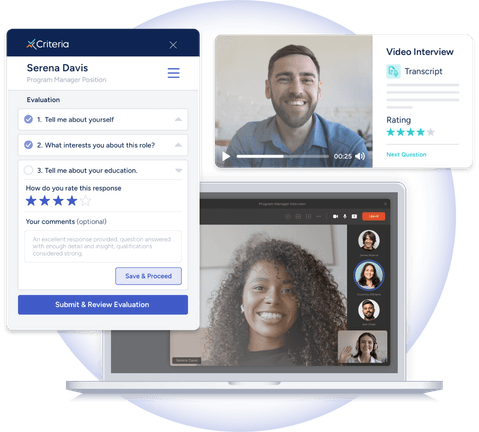
Last quarter, we explored why the resume is no longer a reliable first screen in an AI-heavy hiring environment. This quarter, we move one step deeper into the funnel: the interview.
Watch the on-demand recording to see Criteria's Jam Khan, Chris Daden, and Rachel Zerilla break down how to design interviews that are more ethical, more equitable, and more resistant to AI-driven noise so you can identify real capability, reduce bias, and apply AI responsibly without replacing human judgment.
The interview is where your talent signal gets stronger.
Modern hiring demands stronger signals than a resume can give. A talent signal reveals the science-based qualities that actually predict success, measured across three dimensions. A well-designed interview surfaces all three.
- Potential Signals: Predict future impact: critical thinking, emotional intelligence, and the ability to learn and grow.
- Skills Signals: Verify candidates meet the real requirements of the role, with objective evidence over self-reported claims.
- Performance Signals Show who delivers consistent results, so every hiring decision is fair, explainable, and defensible.
Who Should Attend:
HR leaders, talent acquisition professionals, recruiters, and hiring managers who want to ensure their hiring processes remain fair, reliable, and future-proof in the age of AI.
Meet Your Hosts
Jam Khan
Chief Marketing Officer, Criteria
Jam brings extensive experience across the SaaS landscape, having held roles at ZoomInfo, 6sense, Seismic, Thales, and SafeNet before joining Criteria as our Chief Marketing Officer.


Gary Flowers
CIO of Transformation and Technology, Year Up United
Gary is an award-winning executive and sought-after speaker who leads enterprise-wide digital transformation and leverages innovation to expand career access for young adults and redefine the future of the AI enabled workforce development.
Chris Daden
Chief Technology and AI Officer, Criteria
Chris Daden is Criteria's CTO, a member of the Forbes Technology Council, a Davos speaker, and a Founder several times over.

Rachel Zerilla
Director of Product Marketing, Criteria
Rachel is the Director of Product Marketing at Criteria, where she combines her 15+ years of marketing experience and creative spark to create product magic.
